
|
Following the National Conference theme “gateway to history’s future,” our October program Mountain Men by Dr. Edward Gordon focused on an overview of our country’s westward migration from the Lewis and Clark expedition to the end of the western era in 1890.
Fifty Dames gathered either in-person or via their computers to listen. Most of us were surprised to learn the there is a break in the Rocky Mountains just south of Jackson Hole, Wyoming, hence the major route west to the coast. We all appreciated his maps showing the routes to the west, the wagon trails, California Gold Rush trails and then the railroads.
We were treated to interesting pictures of the wagon trains and were impressed to learn that each wagon train usually consisted of 1000 – 2000 wagons. The biggest risk to the settlers was the danger of drowning while crossing rivers. Given the opportunity, Indians would steal cattle and horses; they generally did not seek skirmishes with the settlers. The Indian peoples relied on the buffalo for sustainance. With the advance of the railroad, the U.S. government gave tribal lands to farmers, causing the buffalo population to decline precipitously between the late 1860’s and the 1890’s. The loss of lands and buffalo caused skirmishes between Indians and settlers to increase during this period. It was interesting to learn that Kit Carson, while an accomplished frontiersman in his own right, became most famous as the subject of a series of paper books, the equivalent of comic book heroes such as Superman in a later era.
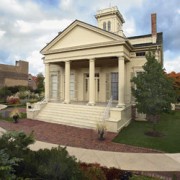

GLESSNER HOUSE
Designed by the legendary American architect Henry Hobson Richardson, this architectural marvel was completed in 1887 and continues to be a renowned treasure in the city of Chicago. A radical departure from traditional Victorian architecture, this revolutionary structure served as a source of inspiration for some of the greatest architects of all time, including Louis Sullivan, Mies van der Rohe, and a young Frank Lloyd Wright. Experience the beauty of this architectural masterpiece and be inspired by how it redefined domestic architecture.
The Story of the Seal
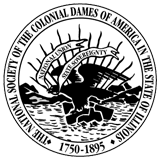
National Union, State Sovereignty (1750-1895). The Illinois Society was founded on December 5, 1895. Incorporation by the Illinois Secretary of State followed on June 30, 1896. The Illinois Society chose as its Seal an adaptation of an earlier Seal of the State of Illinois. There were 22 charter members.